Today is Halloween! A few of the teens came to Energy Net in costume! We celebrated with candy and then the team got down and dirty making models for the December exhibit.
Some of the teens dressed up for Halloween. Lyza was terrifying!
The teens came up with two main activities for the exhibit. The first activity is to make a 3D model of the Four Mile watershed. One group of teens came up with some initial ideas and materials to make a 3D landscape model with hills and valleys. They used a cardboard box, cardboard pieces, brown paper, and tape to form hills and valleys. This is a great start for the model! In the next version the teens want to use a topographic map of the watershed to make the model more realistic.
The beginnings of a 3D watershed model.
The second exhibit activity allows visitors to create a sustainable city. A city diorama with roads and buildings will cover part of the exhibit floor. Visitors will then place green roofs, rain gardens, and rain barrels inside the city and learn how much water the sustainable practices can capture. Visitors will also compare the costs of each practice to choose the most cost effective option.
The teens also played around with using water to show how green roofs and rain barrels soak up and store water. They constructed a model house (cottage cheese container) with tubes as downspouts connected to rain barrels (cups). A sponge on the roof represented a green roof.
Model of a house with a sponge green roof and cups as rain barrels.
This week, the EnergyNet team dove into exhibit planning. After breaking up into groups, each team planned a "Big Idea" to relay to museum guests. The main themes include: an activity to highlight sustainable water management, a watershed model to demonstrate where the water flows, and an overall informative display as to why this is important. From now on, we are working hard to materialize these ideas.
EnergyNet Teens trying testing out a model for inspiration.
Our wonderful exhibit helper, Maryann, brought a previously used model to help the teens visualize some design ideas. The model demostrates combined-sewer overflow, a common problem in Pittsburgh, and how/if green infrastructure remediates this problem.
The video above displays one of the ideas present by the teens. Their goal is to educate the visitors about sustainable practices to slow down the water and use it productively. These techniques will capture water at the site and be used as opposed to running off into the sewer systems.
Stay tuned for the models created by the EnergyNet crew!
Today some of the Energy Net crew came out to volunteer for the Panther Hollow Extravaganza in Schenley Park. Our group was selected to do some hard digging. We picked up our shovels and buckets and headed down to the stream at the bottom of the valley. Our task was to dig out the sediment around one of the bridges that crosses the stream. All this sediment deposited during a rainstorm when water eroded dirt and rocks from the hill slides and deposited it in the stream.
Lyza really getting into the mud.
We removed large logs, sticks, rocks, and dirt that blocked the bridge opening. We hauled dozens of buckets full of sediment from around the bridge with just an hour and a half of work. Now water can easily flow under the bridge. With our jeans muddied up and our task complete, we headed back up to Schenley Plaza for some smiley cookies.
We kicked off the afternoon by learning about the different land surfaces in the Four Mile Watershed. The teen colored in pie charts showing the proportion of different surfaces in the Four Mile watershed. We learned that 40% of the watershed is covered by trees, but 33% of the watershed is impervious surfaces. The impervious surfaces include rooftops 16%, roads 14%, and parking lots 3% of the land surface. All these impervious surfaces move water and pollution quickly into the combined sewer system.
The teens learned trees cover 40% of the watershed and impervious surfaces cover 33%.
The teens then moved to two stations. At the first station the teens learned how much water gravel, pebbles, and sand can store and how quickly water drains through these materials. We learned that gravel stores the least amount of water and water drains quickest through gravel. Sand stores the most water and water drains slowest through sand. These characteristics make sand a good material to use when creating sustainable stormwater practices.
Water storage and drainage activity using gravel, pea pebbles, and sand.
At the second station the teens used materials to recreate the sustainable practices we saw on Tuesday. Teens used sponges and felt to construct rain gardens and green roofs, plastic sheets to represent roadways, and legos to make buildings.
Sponges demonstrate the benefits of green roofs.
After experimenting with different materials the teens presented their best ideas to the group. This video shows one group's idea to use plastic sheets as roadways and sponges to represent previous pavement. They demonstrate the benefit of the pervious pavement by dumping water on the two surfaces. Next week we will continue to develop these ideas for our museum exhibit.
This week we went on a walking tour of our watershed to look for sustainable stormwater management practices, such as rain gardens and green roofs. We visited sustainable sites at the Phipps Conservatory's Living Building, the Schenley Park Visitor's Center, and on Carnegie Mellon's campus. The maps below shows the locations of the stops on our tour.
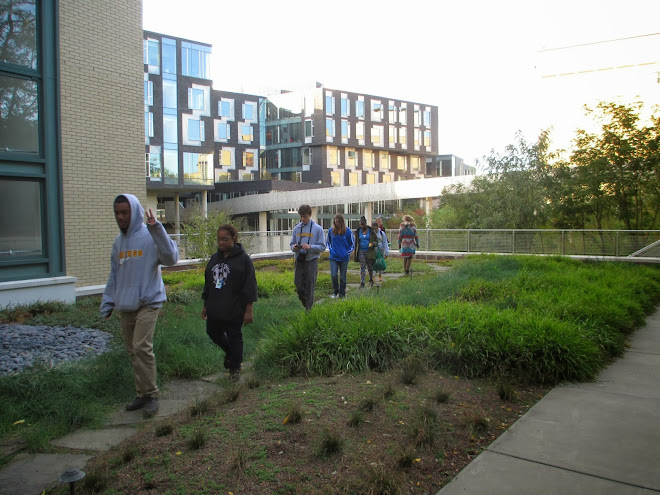
At the Phipps Conservatory we toured the green roof on top of the Center for Sustainable Landscapes. The green roof has 8 inches of soil that is planted with native plant species. The green roof provides habitat for birds and insects, captures stormwater, and saves energy by cooling the building.
The teens exploring the green roof at Phipps.
The green roof also has 50 gallon rain barrels that capture additional water from the roof. The rain barrels store rainwater so Phipps staff can use the water in the barrels to water the plants instead of using tap water.
A 50 gallon rain barrel stores rainwater.
The stormwater lagoon at Phipps takes rainwater runoff from the roofs and filters it through a wetland. The plants use nutrients in the water to help them grow and the water provides habitat for turtles and fish. Once water from the lagoon is cleaned it is stored in large underground tanks.
Stormwater lagoon home to wetland plants and turtles!
We also saw pervious pavement which allows water to drain right through. The teens tested how well the pervious pavement works by dumping water on a section of pervious and impervious pavement. Water soaked right through the pervious pavement! See this video of our demonstration.
We also looked at a couple of rain gardens they have at Phipps. These bowl shaped gardens capture stormwater runoff from the Phipps parking lot. Cuts in the curb allow water to flow from the parking lot into the garden. The plants then use the stormwater and purify it via filtration.
Cuts in the curb allow rainwater runoff to enter the garden.
Group photo by the rain garden at Phipps
After our Phipps tour we headed to the Schenley Park Visitor's Center to look at another smaller rain garden and five 133 gallon rain barrels. The rain garden captures rainwater runoff from 1/3 of the building's roof and the rain barrels capture runoff from the rest of the rooftop.
Anna for scale, showing the large size of the 133 gallon rain barrels.
This rain garden capture roof runoff from 1/3 of the roof.
Our last stop was Carnegie Mellon where we visited three more green roofs.
Posner Hall green roof has large shrubs.
Doherty Hall green roof has small succulent plants and grasses.
After our fieldtrip we came back to the museum to summarize what we learned. The teens identified the problems each practice solved and explained how each practice functions. Next class the teens will use materials to create a model to represent the different sustainable stormwater practices they saw.
This Thursday, the group visited Alcoa's waste water treatment system in New Kensington. There, the teens learned how Alcoa treats their waste water from the kitchens and bathrooms of their facilities. One of their environmental engineers led the tour through their Natural Engineered Wastewater Treatment system, or as they call it, NEWT. The water is first pumped to a wetland area in which air is filtered through in order to allow microbes to flourish. The microbes break down the solid waste, and use it as their own energy. The cattail plants in the wetland also utilize some of the waste as energy. The water is then filtered into a separate pond where it is treated with bauxite residue, a byproduct of Alcoa's aluminum production. The purified water is then tested, to be sure no pollutants remain.
To the right, the wetland area that aids in purifying the wastewater from Alcoa's facilities, to the left is the pond where the water is treated with bauxite
Today kicked off with the teens reviewing information they learned so far about the Four Mile watershed. The teens reviewed how water flows through the watershed, with water draining down from the hilltops to the valleys and eventually to the Monongahela River. The watershed also contains a lot of impervious, hard surfaces such as roads and rooftops. Curbs and storm drains connect the hard surfaces to the combined sewer system. When it rains road runoff picks up pollutants and trash and transports it downstream.
A play dough model explaining how trash gets into a stream or river.
After the review, the teens formed four groups to brainstorm environmental problems in the Four Mile watersheds. Each group came up with a specific water problem and constructed a diagram or model to communicate the problem. Most of the groups focused on urban flooding or trash and pollution. One group of teens used play dough, colored paper, and toothpicks to create a model showing how trash gets into the river. The green play dough represents a forested watershed with no trash in the stream. As the stream flows through an urban area (orange play dough) trash washes into the stream. The teens suggested solving this problem by encouraging residents to recycle.
A model showing how trash and leaves can clog sewer lines.
Another group created a model explaining how trash and leaves can clog sewer lines. The teens used a piece of felt to represent a roadway and a clear plastic tube to represent a sewer pipe. To represent a clogged sewer line the teens added cotton balls and large fabric leaves to the plastic sewer tube. This clog blocks the flow of water and could cause flooding on the street.
At the end of the activity the teens presented their problems and models to the group. This activity will help the teens think about effective ways to communicate their ideas to other people. A skill that will come in handy when they are designing their exhibit.